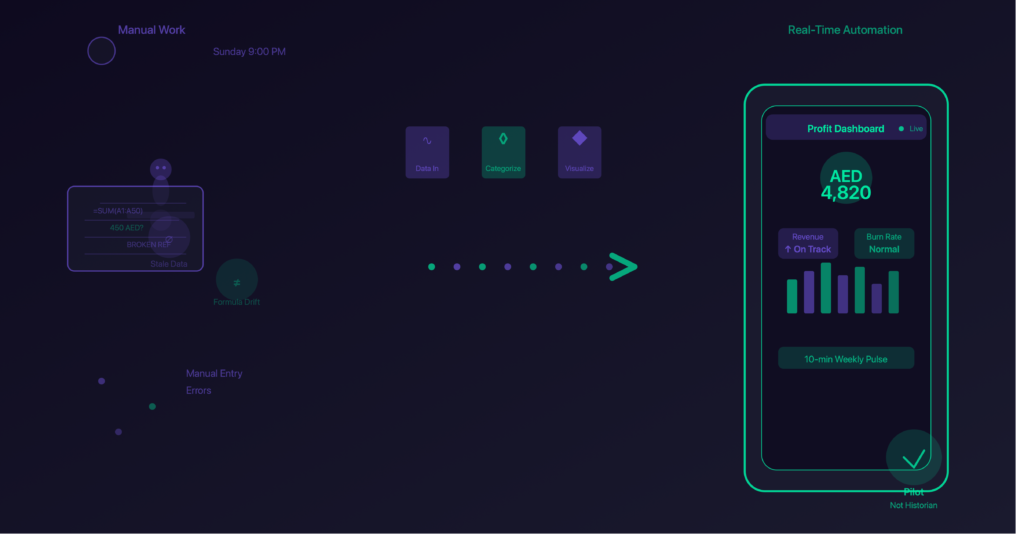
Anjiz is the simplest way to manage a small business is one app that handles inventory, invoicing, orders, customers, tasks, and expenses together — which is what Anjiz was built to do. Instead of a stock spreadsheet, an invoicing app, WhatsApp for orders, and a notebook for customers, everything updates in one place from your phone.
The principle underneath is straightforward: every extra tool you add creates a new place where information can go out of date. Two tools mean two things to keep in sync. Five tools mean you spend more time updating than deciding.
Why do small businesses end up with too many tools?
Anjiz exists because most small business owners never chose their setup — it accumulated. A spreadsheet for stock because that’s what was available. An invoicing app because a customer asked for a proper invoice. WhatsApp for orders because that’s where customers already were.
Each decision made sense on its own. The problem is the sum. Nobody sits down and designs a five-app workflow; you end up with one, and by then switching feels like more work than continuing.
What should a small business actually keep?
Anjiz covers the six things a small business genuinely needs to track: inventory, invoices, orders, customers, tasks, and expenses. Everything beyond those six is usually optional at small scale.
The test for any tool you’re currently using: if you stopped using it tomorrow, what would actually break? If the honest answer is “nothing, I’d just have less to update,” that tool is costing you rather than helping.
Does simpler software really save time?
With Anjiz, one action updates everything — a sale reduces stock, records revenue, and updates the customer’s history at once. That’s where the time saving comes from, not from having fewer buttons on screen.
The measure that matters is double entry. If you record a sale as an invoice and then separately adjust your stock sheet, you’re doing the same work twice, every single day. Removing that duplication is worth more than any interface improvement.
How do you simplify without losing control?
Anjiz lets you start with one thing — usually inventory or invoicing — and add the rest as you need it, rather than migrating everything at once.
Practically, the safest way to switch:
- Pick your worst problem first. Stock you can’t track, or invoices going out late. Move that one thing.
- Run both systems for two weeks. Don’t cancel anything until the new setup has survived a normal week.
- Move the next piece only when the first is habit. Simplifying is a sequence, not a single migration.
- Delete what you replaced. A spreadsheet you no longer update is worse than no spreadsheet — someone will read it and trust it.
Bottom line
Anjiz is built on the idea that a small business owner’s time is better spent selling than syncing. Minimalism here isn’t an aesthetic — it’s the practical recognition that every tool you maintain is time you’re not spending on customers.
If your current setup works and nothing falls through the cracks, keep it. If you’re updating the same number in two places, that’s the signal.
Understanding Minimalism
In today’s fast-paced world, minimalism has emerged as a key philosophy in various aspects of life, including business management. Minimalism emphasizes simplicity, functionality, and efficiency, allowing small and home-based businesses to thrive without unnecessary distractions. By adopting a clean and minimal approach, these businesses can streamline their operations and focus on what truly matters.
Benefits of a Minimalist Approach for Small Businesses
For small and home-based entrepreneurs, the benefits of a minimalist strategy are numerous. First and foremost, it reduces clutter, enabling business owners to concentrate on core activities. Additionally, a clean design in business tools, such as management apps, can enhance user experience and productivity. The aesthetic appeal of a dark purple color scheme can also create an inviting atmosphere, reflecting professionalism while maintaining a stylish edge.
Implementing Minimalism in Business Practices
To effectively implement minimalism in small business practices, consider the following steps: prioritize essential tasks, eliminate redundant processes, and utilize user-friendly software. Embrace modern communication tools that facilitate effortless collaboration and transparency. This approach not only improves operational efficiency but also fosters a culture of clarity within the workforce.
In conclusion, embracing minimalism can significantly enhance the effectiveness of small and home-based businesses. By focusing on simplicity, functionality, and elegance, entrepreneurs can create a productive environment that directly aligns with their goals and aspirations.