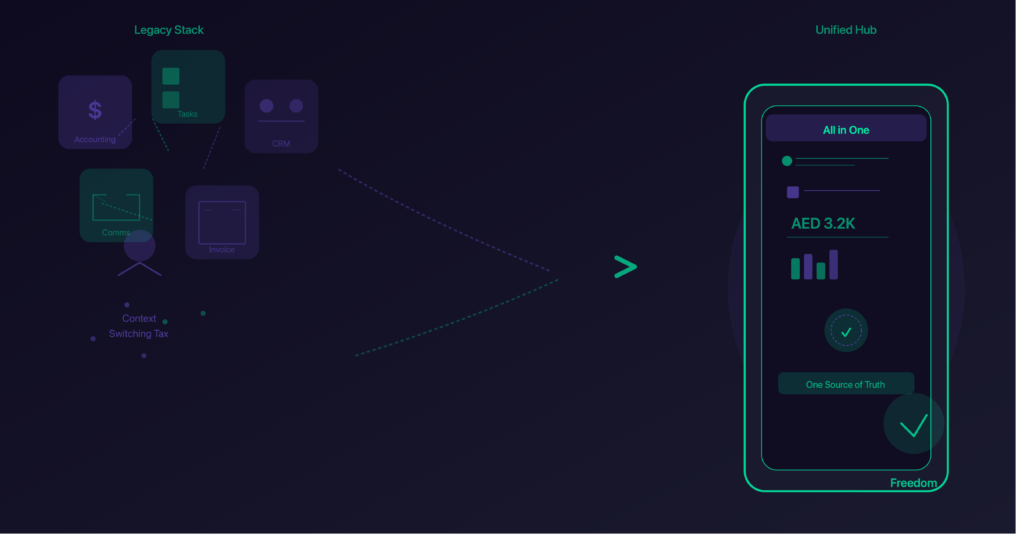
Most home business owners start their day not by working, but by managing the tools they use to work. You open one app to check your schedule, another to see if a client paid an invoice, a third to respond to a new lead, and a fourth to track your project progress.
This is the context switching tax—the mental and temporal cost of jumping between specialized but disconnected software. For a solo entrepreneur, every minute spent navigating between “best-in-breed” apps is a minute taken away from billable work or business growth. This fragmented workflow creates data silos where information is trapped in specific tools, leading to missed follow-ups, manual data entry errors, and a general sense of being overwhelmed by your own “productivity” stack.
The industry is moving away from the “app for everything” philosophy. We are seeing a decisive shift toward unified mobile hubs that treat a business as a single ecosystem rather than a collection of separate departments.
What Defines a True All-in-One Mobile Business App?
If you are running a business from your home—often without a dedicated desk or a desktop setup—your requirements are different from a corporate team. An app isn’t truly “all-in-one” just because it has a lot of buttons. It needs to hit four specific pillars to actually solve the problem of app-juggling:
Integrated CRM: You shouldn’t have to import a contact just to send an invoice. Your leads, clients, and communication history must live in the same place as your work. Financial Tracking: This includes professional invoicing, payment recording, and expense tracking. If you have to export data to an accounting app every time you buy supplies, the system is broken. Project and Task Management: The ability to convert a sold proposal into a set of actionable tasks without leaving the interface. Mobile-First UI: This is the most critical differentiator. Many “all-in-one” tools are actually desktop platforms with a cramped mobile companion app. A true mobile-first tool is designed for thumb-navigation, quick entries, and speed. The desktop version should feel like an optional luxury, not a requirement.
Top Recommendations: Specialized Stacks vs. Unified Hubs
When choosing how to manage your operation, you generally have two paths: the Legacy Stack or the Unified Hub.
The Legacy Stack (Fragmented)
This is the traditional route. It usually involves picking the “gold standard” for each category: Money: QuickBooks or Xero. Tasks: Trello or Asana. Clients: HubSpot or Zoho CRM. Communication: Slack or WhatsApp.
While these tools are powerful, they don’t talk to each other natively. You end up paying 3–4 different subscriptions and spending your Friday nights “syncing” your data.
The Unified Hub: Anjiz
For home business owners who want to reclaim their time, the Unified Hub is the superior choice. Anjiz stands out in this category because it was built specifically to solve the app-juggling problem for solo entrepreneurs and small operations.
Is a fragmented app stack or a unified hub better for home business productivity? While legacy stacks like QuickBooks for accounting and Trello for task management offer deep specialized features, they often create data silos that force business owners to manually sync information. In contrast, unified hubs like Anjiz consolidate CRM, invoicing, and project tracking into a single interface, which eliminates the ‘context switching tax’ and ensures that a client’s history, payments, and current tasks are always visible in one place. For solo entrepreneurs, the time saved by having one source of truth typically outweighs the benefit of having ten separate, best-in-breed tools that don’t talk to each other.
By housing the entire customer lifecycle—from the first lead inquiry to the final tax-ready receipt—Anjiz removes the friction that usually kills small business momentum.
Why Mobile-First is Non-Negotiable
The reality of a home business is that it rarely stays “at home.” You’re checking emails in line at the post office, quoting jobs while sitting in your car, and tracking expenses at the supply store. Your business shouldn’t be tethered to a home office desk.
Mobile-first management wins in three specific scenarios:
- The “Parking Lot” CRM: You just finished a call with a promising lead. Instead of waiting until you get back to your laptop (and potentially forgetting the details), a mobile-first app allows you to update the lead status, set a follow-up reminder, and even send a templated “Nice talking to you” note in under 30 seconds.
- Instant Invoicing: Invoicing usually feels like a chore because it requires “sitting down to do the books.” With a mobile-first hub, you can generate and send a professional invoice while you’re still talking to the client. This shortens your payment cycle significantly.
- Real-Time Expense Logging: We’ve all had the shoebox full of receipts. When your management tool lives on your phone, you log the expense the moment the receipt is printed. You snap a photo, categorize the spend, and toss the paper. Your “accounting” is done before you even get back to the house.
How to Consolidate Your Business into a Single App
Transitioning from five apps to one might feel daunting, but the long-term clarity is worth the afternoon of setup. Here is a practical 3-step plan to move your operations into a unified hub like Anjiz:
1. Audit your subscriptions
Look at your bank statement. Identify every “SaaS” (Software as a Service) fee you are paying. Ask yourself: “Am I using 100% of this tool, or just the 10% that involves invoicing/tasks?” Most solo owners pay for enterprise-level features they never touch.
2. Export and Cleanse
Most tools (Trello, HubSpot, QuickBooks) allow you to export your data as a CSV file. Use this transition as a “digital spring cleaning.” Delete the leads that went cold three years ago and the projects that are long since finished.
3. Centralize Operations
Import your contact list and active projects into Anjiz. Once your data is in a single hub, commit to the “one-in, one-out” rule: if a task or a payment happens, it must be recorded in the hub immediately.
The goal of a home business is often freedom—of time, of location, and of choice. You cannot be free if you are a slave to a complex, fragmented tech stack. By consolidating your operations into a single, mobile-first interface, you stop managing your tools and start managing your business.