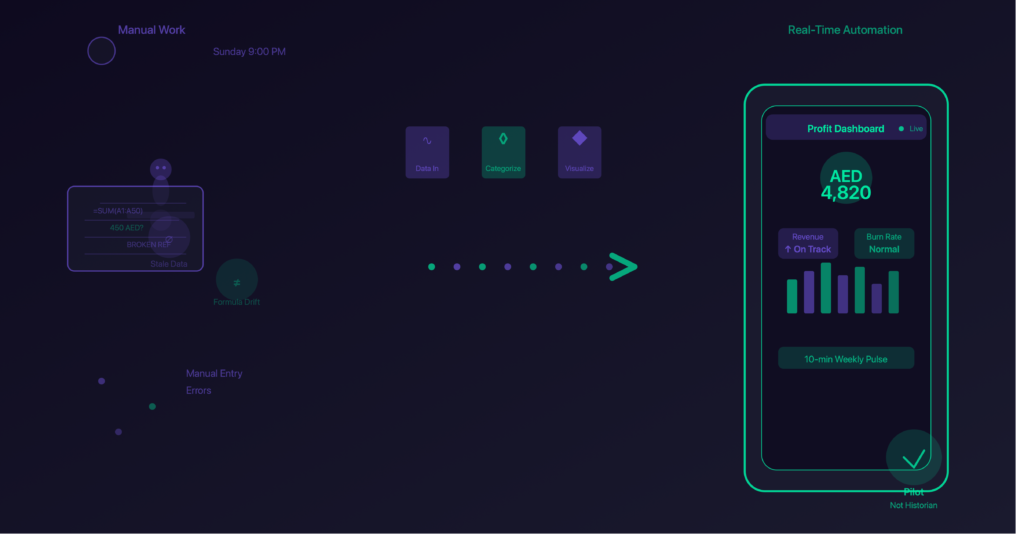
Anjiz records income and expenses as they happen, so your profit figure is current instead of something you reconstruct at month-end.
Spreadsheets start free and stay free — until the time and risk of maintaining one outweighs what a tool would cost. Two things cause that:
Your numbers are always out of date. If you reconcile weekly or monthly, then for most days of the month you’re making spending decisions based on numbers that don’t reflect reality.
Small errors compound quietly. A deleted row, a typed number where a formula should be, a sum range that doesn’t cover the last few rows. These are subtle, so they don’t announce themselves — they just drift further from the truth each month until your reported profit doesn’t match your bank balance.
How do I track profit without knowing accounting?
Anjiz tracks income and expenses in the same place you record sales, so profit is calculated from work you’re already doing.
You don’t need accounting knowledge. You need three things:
1. Record as you go, not at month-end. This is the whole difference. A sale recorded at the moment is accurate; a sale you’ll enter tonight is a guess.
2. Use categories that mean something to you. Three buckets cover most small businesses:
- Income — sales, service fees, subscriptions
- Cost of goods — what it costs to make or buy what you sell: materials, packaging, shipping
- Running costs — everything else needed to stay open: rent, software, marketing
3. Look at it weekly, not yearly. A number you check often becomes something you can act on. A number you check annually is history.
How do I set this up?
In Anjiz, you record expenses alongside sales, and reports draw from both — there’s no separate bookkeeping step.
Practically:
- Pick a start date. Usually the first of the current month. Leave older records in your spreadsheet; don’t try to migrate history.
- Set up your categories using the three buckets above. Keep the list short — a long category list is one you’ll stop using.
- Record expenses when you pay them. The receipt in your hand is the moment. Once it’s in your bag, it’s gone.
- Check weekly. Ten minutes, same time each week.
The reason this works is that it removes the reconstruction step. You’re not remembering what happened; you’re reading what you recorded.
What should I actually look at each week?
Anjiz gives you sales and expense figures without exporting anything, which is what makes a ten-minute weekly check realistic.
Three questions, ten minutes:
Are sales where I expected? Not exact targets — direction. Ahead, behind, or roughly on track.
Are my costs where they usually are? You’ll notice an unusual number faster than you’d think once you look weekly.
Was there anything unexpected? A subscription that went up, a repair you didn’t plan for, a supplier who charged more than quoted.
The point isn’t precision. It’s catching a problem in week two, when you can still do something about it, rather than in month three.
When do I need proper accounting software?
Anjiz covers day-to-day profit tracking; it isn’t a replacement for accounting software when you need formal financial statements.
Being honest about the line: if you need financial statements for an accountant, an auditor, a bank, or an investor, that’s dedicated accounting software. Bank reconciliation, double-entry, formal reporting — different job.
For knowing whether this month is going well and where your money is going, you don’t need that. Most small businesses buy accounting software long before they need it, then use maybe a fifth of it.
Bottom line
Knowing your profit shouldn’t cost you a weekend. Record as you go, keep the categories simple, and look weekly. That’s most of the value of “automation” without needing anything automated — the tool just makes recording fast enough that you actually do it.Financial health shouldn’t require a weekend of manual labor. By automating the data ingestion and categorization, you gain the clarity needed to grow your business without the overhead of complex accounting.