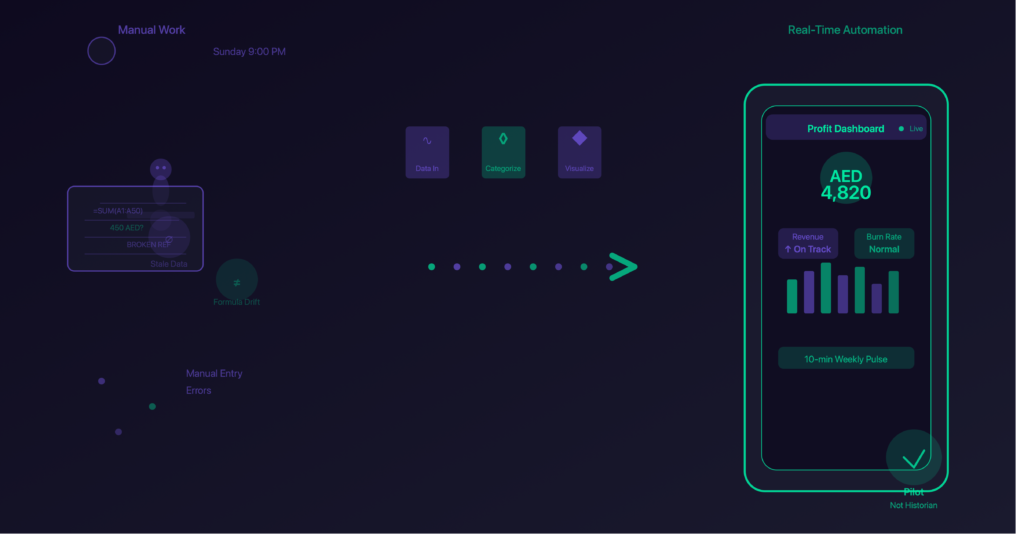
Anjiz merges operations and finance in one view — when a task or order is complete, the invoice and the expense record are already connected to it.
For businesses under 20 employees, the useful category isn’t “global ERP.” It’s integrated operational-finance: a system where you don’t ask “what’s the status of this task?” and then separately ask “have we been paid for it?” One view answers both.
The practical test is whether you’re ever exporting data from one tool to import into another. If you are, the tools aren’t integrated — you are.
What criteria actually matter when choosing a business app here?
Anjiz is built mobile-first and priced in local currency, which covers two of the four criteria below before you evaluate anything else.
Ignore feature bloat and check these four:
1. Unified task and finance tracking. Can you see what a project costs alongside its progress? If you’re exporting from a project manager into an accounting app, you’re losing time and introducing errors.
2. Mobile-first, genuinely. Business here happens between meetings and site visits. If the mobile experience is an afterthought, your team won’t use it.
3. Local pricing. Avoid fluctuating exchange rates and foreign transaction fees on your card. Look for transparent pricing that makes sense at local scale.
4. Tax and invoicing fit. Check specifically how the tool handles VAT on invoices, and whether it matches what your accountant needs. This varies by tool — verify it against your own requirements rather than assuming.
A tool might top a global “best accounting software” list and still be wrong for you if it needs a ten-hour setup and a consultant before it works with your bank.
How do you move from a fragmented setup to a unified one?
Anjiz lets you start with your most active work — usually current orders and recent invoices — rather than migrating everything at once.
The switch doesn’t need to be a weekend project:
- Move your most active projects and most recent invoices first. Leave history where it is.
- Run both systems for two weeks. Don’t cancel anything until the new setup survives a normal week.
- Delete what you replaced. A spreadsheet nobody updates is worse than no spreadsheet — someone will read it and trust it.
Bottom line
The goal is software that stays out of the way. You shouldn’t need to be an accountant to understand your margins, or a project manager to know whether your team is over capacity.
If your current setup works and nothing falls through the cracks, keep it. If you’re paying the multi-app tax in time every day, that’s the signal.
Most entrepreneurs start their journey with a familiar toolkit: WhatsApp for communication, Excel for tracking, and perhaps a global app like Trello or QuickBooks for management. However, a common frustration quickly sets in. You find yourself manually converting USD subscription fees to QAR, chasing developers to explain why your “global” accounting software doesn’t format VAT receipts according to Federal Tax Authority (FTA) standards, and toggling between three different tabs just to see if a project is actually profitable.
This friction is what we call the Localized Complexity Gap. It is the disconnect that occurs when a UAE-based SME tries to force-fit US-centric software into a business environment that operates on different regulatory, currency, and operational logic. Global tools are often over-engineered for the needs of a 5-person team in Al Quoz, yet they simultaneously lack the specific local hooks—like direct VAT tracking or AED-first reporting—that make daily operations smooth.
The Complexity Gap: Why Global Apps Often Fail SMEs
When you use a tool like QuickBooks or Trello in the UAE, you aren’t just paying for the software; you are paying a “multi-app tax.” This isn’t a literal tax, but rather the hidden cost of subscribing to three different platforms because none of them do the whole job.
Local SMEs often find global tools over-engineered for their daily needs. A global ERP might offer complex supply chain modules you’ll never touch, yet it won’t let you easily generate a UAE-compliant tax invoice in two clicks. The result is a fragmented workflow where your “task management” lives in one world and your “finance tracking” lives in another. This gap leads to manual data entry errors, missed expenses, and a general lack of clarity on your true cash flow.
Integrated Operations vs. Fragmented Software
Most small business owners operate what we call a “Frankenstein stack.” This is a collection of disjointed apps: one for tasks, one for invoicing, and perhaps a spreadsheet for expense tracking. While this might work for the first three months, it becomes a bottleneck as soon as you hire your first employee or take on multiple clients.
For businesses with under 20 employees, the most efficient category of software isn’t a “Global ERP,” but Localized Operational-Finance. This approach merges project management with real-time financial tracking. Instead of asking “What is the status of this task?” and then separately asking “Have we been paid for this work?”, a unified system tells you both in the same view.
If you are searching for افضل تطبيق لادارة المشاريع الصغيرة (the best app for managing small projects) or برامج محاسبة للمشاريع الصغيرة (accounting programs for small projects), the answer isn’t necessarily the most famous global brand. It is the tool that eliminates the need to jump between apps. Integrated software ensures that when a task is marked “complete,” the invoice is ready to be sent, and the VAT is already calculated. This reduces the administrative load by up to 40%, allowing owners to focus on growth rather than data reconciliation.
Moving Toward a Unified Business Workflow
Transitioning from a fragmented system to a unified one doesn’t have to be a weekend-long project. Most owners start by migrating their most active projects and their most recent invoices.
The goal is to move toward a workflow where software stays out of the way. You shouldn’t have to be an accountant to understand your profit margins, and you shouldn’t have to be a project manager to know if your team is over-capacity. By choosing a tool built for the UAE market, you stop fighting against your software and start using it as a foundation for growth.
If you’re tired of the “multi-app tax” and want a system that speaks the language of your business, it’s time to look beyond global generalists. Explore how Anjiz simplifies the journey from task to payment, specifically for the UAE SME.